

How To Repair Steering Rod On A Bolens 38 Inch Cut Rideing Mower

Part of car steering mechanism: necktie rod, steering arm, king pin axis (using ball joints)
Steering is a organisation of components, linkages, etc. that allows a vehicle to follow a desired course. An exception is the case of rail ship, by which rail tracks combined with railroad switches (also known as 'points' in British English language) provide the steering function. The primary purpose of the steering system is to allow the commuter to guide the vehicle.
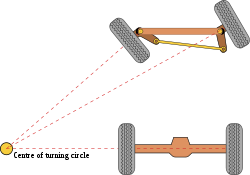
Ackermann steering geometry
Introduction [edit]
The almost conventional steering arrangement is to turn the forepart wheels using a hand–operated steering wheel which is positioned in front of the driver, via the steering column, which may contain universal joints (which may besides exist part of the collapsible steering column design), to allow it to deviate somewhat from a directly line. Other arrangements are sometimes found on different types of vehicles; for case, a tiller or rear–wheel steering. Tracked vehicles such as bulldozers and tanks usually utilise differential steering—that is, the tracks are made to motility at different speeds or even in reverse directions, using clutches and brakes, to attain a change of direction.
Land vehicle steering [edit]
Basic geometry [edit]
-

Ackermann steering
-

Bell-crank steering
-
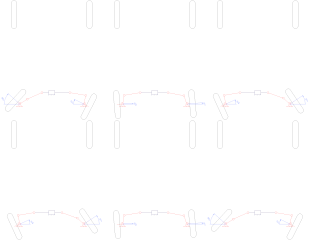
Rack-and-pinion steering
-
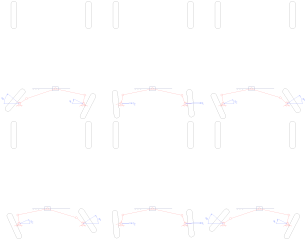
Short rack-and-pinion steering

Pulley bending θ indicates kingpin pin line and gray area indicates vehicle'due south tire with the cycle moving from right to left. A positive pulley angle aids in directional stability, as the wheel tends to trail, but a large bending makes steering more than difficult.
Curves described by the rear wheels of a conventional automobile. While the vehicle moves with a constant speed its inner and outer rear wheels do not.
The bones aim of steering is to ensure that the wheels are pointing in the desired directions. This is typically achieved by a series of linkages, rods, pivots and gears. One of the cardinal concepts is that of caster angle—each wheel is steered with a pivot point ahead of the wheel; this makes the steering tend to be cocky-centering towards the management of travel.
The steering linkages connecting the steering box and the wheels usually conform to a variation of Ackermann steering geometry, to account for the fact that in a turn, the inner wheel travels a path of smaller radius than the outer wheel, so that the caste of toe suitable for driving in a straight path is non suitable for turns. The angle the wheels make with the vertical plane, known as camber angle, likewise influences steering dynamics as practise the tires.
Rack and pinion, recirculating ball, worm and sector [edit]
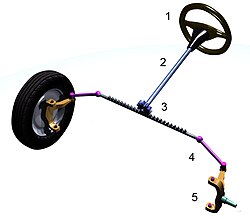
Rack and pinion steering mechanism: 1 steering wheel; 2 steering column; 3 rack and pinion; 4 tie rod; five kingpin

Rack and pinion unit mounted in the cockpit of an Ariel Atom sports car chassis, atypical of contemporary production automobiles

Non-assisted steering box of a motor vehicle
Many modern cars use rack and pinion steering mechanisms, where the steering cycle turns the pinion gear; the pinion moves the rack, which is a linear gear that meshes with the pinion, converting round motion into linear move forth the transverse axis of the car (side to side motion). This movement applies steering torque to the hinge pin ball joints (that replaced previously used kingpins) of the stub axle of the steered wheels via tie rods and a brusque lever arm called the steering arm.
The rack and pinion design has the advantages of a large degree of feedback and direct steering "experience". A disadvantage is that it is not adaptable, so that when it does wear and develop lash, the but resolution is replacement.
BMW began to use rack and pinion steering systems in the 1930s, and many other European manufacturers adopted the technology. American automakers adopted rack and pinion steering beginning with the 1974 Ford Pinto.[1]
Older designs use ii main principles: the worm and sector pattern and the spiral and nut. Both types were enhanced by reducing the friction; for spiral and nut it is the recirculating brawl mechanism, which is still found on trucks and utility vehicles. The steering column turns a large screw which meshes with the nut by recirculating assurance. The nut moves a sector of a gear, causing it to rotate nigh its axis as the spiral is turned; an arm fastened to the axis of the sector moves the Pitman arm, which is connected to the steering linkage and thus steers the wheels. The recirculating brawl version of this apparatus reduces the considerable friction past placing large ball bearings between the screw and the nut; at either end of the apparatus the balls exit from betwixt the 2 pieces into a channel internal to the box which connects them with the other finish of the apparatus; thus, they are "recirculated".
The recirculating ball mechanism has the advantage of a much greater mechanical advantage, and so that it was found on larger, heavier vehicles while the rack and pinion was originally limited to smaller and lighter ones; due to the almost universal adoption of power steering, however, this is no longer an important reward, leading to the increasing use of rack and pinion on newer cars. The recirculating ball design also has a perceptible lash, or "dead spot" on center, where a minute turn of the steering wheel in either direction does not move the steering appliance; this is easily adaptable via a screw on the end of the steering box to business relationship for wear, but it cannot exist eliminated because it volition produce excessive internal forces at other positions and the mechanism will habiliment very rapidly. This design is however in use in trucks and other large vehicles, where rapidity of steering and direct feel are less of import than robustness, maintainability, and mechanical reward.
The worm and sector was an older design, used for example in Willys and Chrysler vehicles, and the Ford Falcon (1960s). To reduce friction the sector is replaced by a roller or rotating pins on the rocker shaft arm.
More often than not, older vehicles use the recirculating brawl machinery, and only newer vehicles employ rack-and-pinion steering. This partitioning is not very strict, notwithstanding, and rack-and-pinion steering systems can be found on British sports cars of the mid-1950s, and some High german carmakers did non give up recirculating ball technology until the early on 1990s.
Other systems for steering exist, but are uncommon on road vehicles. Children's toys and go-karts oftentimes use a very directly linkage in the form of a bellcrank (also normally known as a Pitman arm) attached directly between the steering column and the steering arms, and the apply of cable-operated steering linkages (due east.g. the capstan and bowstring mechanism) is too found on some home-built vehicles such as discourse cars and recumbent tricycles.
Power steering [edit]
Power steering helps the driver of a vehicle to steer by directing some of its engine ability to assistance in swiveling the steered route wheels about their steering axes. Equally vehicles take get heavier and switched to front-bike drive, particularly using negative first geometry, along with increases in tire width and diameter, the try needed to turn the wheels nigh their steering axis has increased, oftentimes to the betoken where major physical exertion would exist needed were it non for power aid. To convalesce this, auto makers accept developed power steering systems, or more correctly power-assisted steering, since on road-going vehicles there has to be a mechanical linkage equally a neglect-safe. At that place are ii types of power steering systems: hydraulic and electric/electronic. A hydraulic-electrical hybrid organization is as well possible.
A hydraulic power steering (HPS) uses hydraulic pressure supplied by an engine-driven pump to aid the move of turning the steering wheel. Electrical power steering (EPS) is more than efficient than hydraulic power-steering, since the electric ability-steering motor only needs to provide help when the steering wheel is turned, whereas the hydraulic pump must run constantly. In EPS, the corporeality of assistance is easily tunable to the vehicle blazon, road speed, and commuter preference. An added benefit is the elimination of the environmental hazard posed by leakage and disposal of hydraulic ability-steering fluid. In addition, electrical assistance is non lost when the engine fails or stalls, whereas hydraulic assistance stops working if the engine stops, making the steering doubly heavy as the driver must at present turn not only the very heavy steering—without whatever help—simply likewise the power-assistance organisation itself.
Speed-sensitive steering [edit]
A evolution of ability steering is speed-sensitive steering, where the steering is heavily assisted at low speed and lightly assisted at high speed. Auto makers perceive that motorists might need to make large steering inputs while manoeuvering for parking, just non while traveling at high speed. The offset vehicle with this characteristic was the Citroën SM with its Diravi layout,[2] although rather than altering the amount of aid every bit in modern power steering systems, information technology altered the pressure on a centering cam which made the steering wheel try to "spring" back to the directly-ahead position. Modern speed-sensitive power steering systems reduce the mechanical or electrical assistance as the vehicle speed increases, giving a more than direct feel. This feature is gradually becoming more common.[ timeframe? ]
Four-wheel steering [edit]

Honda Prelude Mk III rear steering box

Speed-dependent iv-cycle steering.

Early case of four-wheel steering. 1910 photo of 80 hp Caldwell Vale tractor in action.

1937 Mercedes-Benz Type 1000 v with four-bike steering.


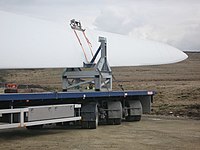
Heavy transport trailer with all-cycle steering remote controlled past a steersman walking at the rear of the trailer (2008).


Hamm DV70 tandem roller using crab steering to cover maximum route surface (2010).

Agricultural slurry applicator using crab steering to minimise soil compaction (2009).
Four-cycle steering is a organisation employed by some vehicles to meliorate steering response, increase vehicle stability while maneuvering at high speed, or to subtract turning radius at low speed.
Active four-cycle steering [edit]
In an agile four-wheel steering organisation, all four wheels turn at the same fourth dimension when the commuter steers. In most active four-wheel steering systems, the rear wheels are steered past a estimator and actuators.[3] The rear wheels by and large cannot turn as far as the forepart wheels. There can be controls to switch off the rear steering and options to steer but the rear wheels independently of the front wheels. At low speed (eastward.thou. parking) the rear wheels turn opposite to the front wheels, reducing the turning radius, sometimes critical for large trucks, tractors, vehicles with trailers and passenger cars with a big wheelbase, while at higher speeds both front and rear wheels turn akin (electronically controlled), then that the vehicle may change position with less yaw and improved build-up of the lateral acceleration, enhancing directly-line stability.[3] [four] The "snaking effect" experienced during expressway drives while towing a travel trailer is thus largely nullified.[ dubious ]
Four-wheel steering found its most widespread employ in monster trucks, where maneuverability in small arenas is critical, and it is also popular in large subcontract vehicles and trucks. Some of the modern European Intercity buses likewise utilise four-wheel steering to assist maneuverability in autobus terminals, and also to improve road stability. Mazda were pioneers in applying four-wheel steering to automobiles, showing information technology on their 1984 Mazda MX-02 concept car, where the rear wheels counter-steered at low speeds.[5] Mazda proceeded to offer a version of this electronic four-wheel steering system on the Mazda 626 and MX6 in 1988. The commencement rally vehicle to utilise the technology was the Peugeot 405 Turbo 16, which debuted at the 1988 Pikes Summit International Hill Climb.[6]
Previously, Honda had 4-wheel steering as an option in their 1987–2001 Prelude and Honda Ascot Innova models (1992–1996). Full general Motors offered Delphi's Quadrasteer in their Silverado/Sierra and Suburban/Yukon. Due to low demand, GM discontinued the technology at the terminate of the 2005 model year.[vii] Nissan/Infiniti offer several versions of their HICAS system as standard or as an option in much of their line-up.
In the early 2000s, a new generation of 4-wheel steering systems was introduced into the market. In 2001 BMW equipped the E65 7 serial with an all-wheel steering system (optional, chosen 'Integral Agile Steering'), which is available on the electric current v, half dozen, and 7 series,[8] [ix] [iv] as an choice. Renault introduced an optional all-wheel steering called '4control'[10] [11] [12] in 2009, at first on the Laguna GT, which is currently available on the Talisman,[eleven] Mégane[10] and Espace[12] vehicle lines. In 2013, Porsche introduced a organisation on the 911 Turbo equally standard equipment.[13] Since 2016, the Panamera has been offered with optional all-wheel steering.[14] The 2014 Audi Q7 was launched with an optional organization.[xv] As well the Japanese OEMs offering luxury segment vehicles equipped with all-bicycle steering, such as Infiniti on its QX70 model ('Rear Active Steering')[16] and Lexus on the GS.[17] Italian manufacturers take launched the technology in the model years 2016–17 with the Ferrari F12tdf,[xviii] the Ferrari GTC4Lusso[xix] as well every bit the Lamborghini Aventador S Coupé.[twenty]
Crab steering [edit]
Crab steering is a special type of active four-wheel steering. It operates by steering all wheels in the aforementioned management and at the same angle. Crab steering is used when the vehicle needs to keep in a straight line but at an angle: when irresolute lanes on a highway at speed, when moving loads with a reach truck, or during filming with a camera dolly.
Rear wheel steering can also exist used when the rear wheels may not follow the path taken past the front end bicycle tracks (e.g. to reduce soil compaction when using rolling subcontract equipment).
Passive rear-cycle steering [edit]
Many modern[ timeframe? ] vehicles have passive rear-cycle steering. On many vehicles, when cornering, the rear wheels tend to steer slightly to the exterior of a turn, which tin reduce stability. The passive steering system uses the lateral forces generated in a turn (through suspension geometry) and the bushings to correct this tendency and steer the wheels slightly to the inside of the corner. This improves the stability of the automobile through the turn. This effect is called compliance understeer; it, or its contrary, is present on all suspensions. Typical methods of achieving compliance understeer are to use a Watt's link on a live rear axle, or the employ of toe control bushings on a twist beam suspension. On an independent rear pause it is normally achieved by changing the rates of the rubber bushings in the suspension. Some suspensions typically have compliance oversteer due to geometry, such every bit Hotchkiss live axles, semi-trailing arm IRS, and rear twist beams, but may be mitigated by revisions to the pin points of the leafage leap or abaft arm, or additional intermission links, or circuitous internal geometry of the bushings.
Passive rear-wheel steering is not a new concept, as it has been in utilise for many years,[ timeframe? ] although not always recognised as such.
Articulated steering [edit]
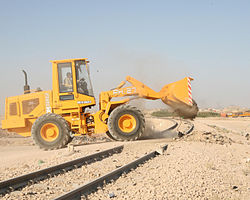
Front loader with articulated steering (2007).
Articulated steering is a system by which a vehicle is split into front and rear halves which are connected by a vertical hinge. The front and rear halves are connected with one or more hydraulic cylinders that alter the angle between the halves, including the front end and rear axles and wheels, thus steering the vehicle. This organization does non apply steering arms, king pins, necktie rods, etc. as does four-wheel steering. If the vertical swivel is placed equidistant between the ii axles, information technology also eliminates the demand for a central differential in iv-bike drive vehicles, as both front and rear axles will follow the aforementioned path, and thus rotate at the same speed. Articulated haulers have very adept off-road performance.
Vehicle-trailer-combinations such every bit semi-trailers, road trains, articulated buses, and internal transport trolley trains can exist regarded as passively-articulated vehicles.
Rear-wheel steering [edit]
A few types of vehicle use only rear-wheel steering, notably fork lift trucks, camera dollies, early pay loaders, Buckminster Fuller's Dymaxion car, and the ThrustSSC.[21]
In cars, rear-cycle steering tends to exist unstable because, in turns, the steering geometry changes, hence decreasing the turn radius (oversteer), rather than increasing it (understeer). Rear-wheel steering is meant for slower vehicles that need high-maneuverability in tight spaces, e.g. fork lifts.
For heavy haulage or for increased manoeuvrability, some semi-trailers are fitted with rear-wheel steering, controlled electro-hydraulically. The wheels on all or some of the rear axles may exist turned through different angles to enable tighter cornering, or through the same angle (crab steering) to motion the rear of the trailer laterally.
Steer-by-wire [edit]
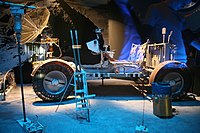
1971 Lunar Roving Vehicle (LRV) with joystick steering controls.

2012 Honda EV-STER "Twin Lever Steering" concept.
The aim of steer-past-wire engineering science is to completely remove equally many mechanical components (steering shaft, column, gear reduction machinery, etc.) as possible. Completely replacing conventional steering organisation with steer-past-wire has several advantages, such as:
- The absence of steering column simplifies the car interior design.
- The absenteeism of steering shaft, column and gear reduction mechanism allows much better infinite utilization in the engine compartment.
- The steering mechanism can be designed and installed as a modular unit.
- Without mechanical connection between the steering wheel and the route bicycle, information technology is less likely that the impact of a frontal crash will crusade the steering wheel to impact the driver.
- Steering system characteristics tin can easily exist adjusted to change the steering response and experience.
As of 2020 there are no production cars bachelor that rely solely on steer-by-wire technology due to safety, reliability and economical concerns, but this technology has been demonstrated in numerous concept cars and the similar fly-past-wire applied science is in apply in both military and civilian aviation applications.
Prophylactic [edit]
For safe reasons all modern cars characteristic a collapsible steering cavalcade (free energy absorbing steering column) which will collapse in the event of a heavy frontal impact to avoid excessive injuries to the driver. Airbags are also generally fitted every bit standard. Non-collapsible steering columns fitted to older vehicles very often impaled drivers in frontal crashes, particularly when the steering box or rack was mounted in front of the front beam line, at the front end of the crumple zone. This was especially a trouble on vehicles that had a rigid separate chassis frame with no crumple zone. Many modern vehicle steering boxes or racks are mounted behind the forepart axle on the front bulkhead, at the rear of the front crumple zone.
Collapsible steering columns were invented by Béla Barényi and were introduced in the 1959 Mercedes-Benz W111 Fintail, along with crumple zones. This safe feature showtime appeared[ when? ] on cars built by General Motors after an extensive and very public lobbying campaign enacted by Ralph Nader. Ford started to install collapsible steering columns in 1968.[22]
Audi used a retractable steering wheel and seat belt tensioning system called procon-ten, but it has since been discontinued in favor of airbags and pyrotechnic seat belt pre-tensioners.
Cycles [edit]
![[icon]](https://upload.wikimedia.org/wikipedia/commons/thumb/1/1c/Wiki_letter_w_cropped.svg/20px-Wiki_letter_w_cropped.svg.png) | This section is empty. You can aid by adding to information technology. (August 2021) |
Differential steering [edit]
Differential steering is the primary ways of steering tracked vehicles, such as tanks and bulldozers; it is also used in certain wheeled vehicles commonly known as skid-steers, and implemented in some automobiles, where information technology is called torque vectoring, to augment steering by changing wheel direction relative to the vehicle.
Regulations [edit]
In the European Spousal relationship, Russia and Nihon, UNECE regulation 79 is related to steering.
In the Usa, Federal Motor Vehicle Safety Standards 203 and 204 are related to impact protection for the driver from the steering control arrangement and steering command rearward displacement while 49 Code of Federal Regulations § 393.209 is related to steering wheel systems.
Watercraft steering [edit]
Ships and boats are usually steered with a rudder. Depending on the size of the vessel, rudders tin be manually actuated, or operated using a servomechanism, or a trim tab or servo tab system. Boats using outboard motors steer past rotating the entire drive unit of measurement. Boats with inboard motors sometimes steer by rotating the propeller pod but (i.due east. Volvo Penta IPS bulldoze). Modern ships with diesel-electric drive use azimuth thrusters. Boats power by oars or paddles are steered by generating a college propulsion force on the side of the gunkhole opposite of the direction of turn. Jet skis are steered by weight-shift induced curlicue and water jet thrust vectoring.
The rudder of a vessel tin steer the ship only when water is passing over information technology. Hence, when a ship is non moving relative to the water it is in or cannot move its rudder, it does not respond to the helm and is said to have "lost steerage". The motion of a send through the water is known as "making manner". When a vessel is moving fast enough through the water that information technology turns in response to the captain, it is said to have "steerage way".[23] That is why boats on rivers must ever exist under propulsion, fifty-fifty when traveling downstream.
Aircraft and hovercraft steering [edit]
Airplanes are normally steered when airborne past the employ of ailerons, spoilerons, or both to bank the aircraft into a turn; although the rudder can also exist used to plow the aircraft, it is unremarkably used to minimise adverse yaw, rather than as a means to directly crusade the plow. On the ground, aircraft are generally steered at low speeds by turning the nosewheel or tailwheel (using a tiller or the rudder pedals) or through differential braking, and past the rudder at high speeds. Missiles, airships and large hovercraft are usually steered past a rudder, thrust vectoring, or both. Small sport hovercraft have like rudders, but steer mostly by the airplane pilot shifting their weight from side to side and unbalancing the more powerful lift forces beneath the brim. Jet packs and flight platforms are steered by thrust vectoring only. Helicopters are steered by circadian control, changing the thrust vector of the main rotor(south), and by anti-torque control, ordinarily provided by a tail rotor.
See also [edit]
- Agile Yaw Control (AYC)
- Crash-land Steer
- Camber angle
- Camber thrust
- Pulley angle
- Countersteering
- DIRAVI
- Dry out steering
- HICAS
- Kingpin
- Opposite lock
- Ability steering
- Skid steer
- Steer-by-wire
- Steering damper
- Steering kickback
- Steering ratio
- Steering wheel
- Steering wheel (ship)
- Tiller
- Torque steering
- Turning radius
- Vehicle dynamics
References [edit]
- Encyclopedia of High german Tanks of World War Ii by Peter Chamberlain and Hilary Doyle, 1978, 1999
- ^ "Archived copy". Archived from the original on 2015-07-10. Retrieved 2015-07-24 .
{{cite web}}: CS1 maint: archived copy as title (link) - ^ "Archived copy". Archived from the original on 2015-05-xi. Retrieved 2015-05-28 .
{{cite spider web}}: CS1 maint: archived copy every bit title (link) - ^ a b "Cars | AKC® - Agile Kinematics Control - ZF Friedrichshafen AG". www.zf.com. Archived from the original on 2017-04-07. Retrieved 2017-04-06 .
- ^ a b AG, BMW. "BMW 5 Series Sedan: Driving dynamics & Efficiency". www.bmw.com. Archived from the original on 2017-04-06. Retrieved 2017-04-06 .
- ^ Lindell, Hannu (1985-03-nineteen). "Nelosten vuosi" [Year of the Four]. Tekniikan Maailma (in Finnish). Vol. 41, no. 5/85. Helsinki: TM-Julkaisu. p. Automaailma 3. ISSN 0355-4287.
- ^ "1988 Peugeot 405 T16 GR Pikes Peak". Retrieved 2015-03-xvi .
- ^ Murphy, Tom; Corbett, Brian (2005-03-01). "Quadrasteer Off Course". Wards Machine World. Archived from the original on 2011-03-23. Retrieved 2010-06-eleven .
- ^ AG, BMW. "BMW vii Series Sedan : M Performance". www.bmw.com. Archived from the original on 2017-04-06. Retrieved 2017-04-06 .
- ^ AG, BMW. "BMW 6 Series Coupé : Driving dynamics". www.bmw.com. Archived from the original on 2017-04-06. Retrieved 2017-04-06 .
- ^ a b "Feature | All-New MEGANE Sport Tourer | Cars | Renault Great britain". Renault. Archived from the original on 2017-04-06. Retrieved 2017-04-06 .
- ^ a b "Equipements | Talisman | Véhicules Particuliers | Véhicules | Renault FR". Renault (in French). Archived from the original on 2017-04-07. Retrieved 2017-04-06 .
- ^ a b "Equipements | Espace | Véhicules Particuliers | Véhicules | Renault FR". Renault (in French). Archived from the original on 2017-04-07. Retrieved 2017-04-06 .
- ^ "Porsche 911 Turbo - Rear-axle steering - Porsche United kingdom of great britain and northern ireland". Porsche Great Britain - Dr. Ing. h.c. F. Porsche AG. Archived from the original on 2017-04-07. Retrieved 2017-04-06 .
- ^ "Porsche The new Panamera - Rear-beam steering - Porsche Great Uk". Porsche Great U.k. - Dr. Ing. h.c. F. Porsche AG. Archived from the original on 2017-04-06. Retrieved 2017-04-06 .
- ^ "Audi Q7 > Audi configurator United kingdom". www.united kingdom.audi.com. Archived from the original on 2017-04-06. Retrieved 2017-04-06 .
- ^ "INFINITI QX70 Specs - Performance Features & Engine Options". Infiniti. Archived from the original on 2017-04-06. Retrieved 2017-04-06 .
- ^ "News&Events, Neuigkeiten". world wide web.lexus.de (in High german). Archived from the original on 2017-02-22. Retrieved 2017-04-06 .
- ^ "Ferrari F12tdf: Rails-Level Performance on the Road - Ferrari.com". Ferrari GT - en-EN. Archived from the original on 2017-04-07. Retrieved 2017-04-06 .
- ^ "GTC4LUSSO T: maximum control for a unique driving feel". GTC4Lusso T. Archived from the original on 2017-04-07. Retrieved 2017-04-06 .
- ^ "Lamborghini Aventador S Coupé". world wide web.lamborghini.com. Archived from the original on 2017-04-25. Retrieved 2017-04-06 .
- ^ "Thrust SSC - Engineering". Archived from the original on 2010-eleven-12. Retrieved 2010-05-26 .
- ^ Smart, Jim. "Collapsible Steering Column Installation". Archived from the original on 2006-12-28.
- ^ Smyth, William Henry; Belcher, Edward (1867). The crewman'southward word-book: An alphabetical digest of nautical terms, including some more especially armed forces and scientific ... as well as archaisms of early voyagers, etc. London: Blackie and Son. p. 654.
External links [edit]
 | Look up steering in Wiktionary, the free dictionary. |
- How Motorcar Steering Works (HowStuffWorks.com)
- 2000 technical paper on the kinematic design of rack-and-pinion steering linkages
- 2002 technical paper on the kinematic blueprint of bellcrank steering linkages

Source: https://en.wikipedia.org/wiki/Steering
Posted by: haneyliner1983.blogspot.com
0 Response to "How To Repair Steering Rod On A Bolens 38 Inch Cut Rideing Mower"
Post a Comment